Japanese Kamon – The Art of Family Crests
Origins and History
Japanese Kamon (家紋) are sophisticated symbols representing
lineage, history, and the natural world.
-
Heian Period (794–1185): Originally used by
aristocrats to identify their ox carriages and silk robes in the
imperial court.
-
Kamakura Period (1185–1333): Adopted by the Samurai
class. Crests became vital on the battlefield to distinguish friend
from foe on banners (nobori) and armor.
-
Edo Period (1603–1867): Usage spread to commoners
(merchants and artisans), evolving into a standardized heraldic system
used for formal wear.
Design Philosophy
Minimalism and Geometry
Kamon are celebrated globally for their "less is more"
aesthetic.
-
Circular Framing: Most designs are contained within a
circle (maru), representing harmony and the infinite.
-
Abstraction: Complex subjects (like birds or flowers)
are distilled into bold, monochromatic shapes for maximum legibility.
-
Mathematical Precision: Designs often rely on
compass-and-ruler geometry, utilizing rotational or reflective
symmetry.
Common Motifs and Meanings
Nature as a Narrative
| Category |
Example |
Symbolic Meaning |
| Plant |
Kiku (Chrysanthemum) |
The Imperial family, longevity, and rejuvenation.
|
| Plant |
Kiri (Paulownia) |
Government authority and good fortune. |
| Animal |
Tsuru (Crane) |
1,000-year life, peace, and marital loyalty. |
| Object |
Ogi (Folding Fan) |
Expansion, prosperity, and military command. |
Famous Historical Kamon
Symbols of Power and Influence

The Tokugawa Clan (Mitsuba Aoi): The Triple
Hollyhock.
This crest was so revered that unauthorized use was a punishable crime
during the Shogunate.
Famous Historical Kamon
Symbols of Power and Influence

The Oda Clan (Oda Mokkou): The Quince.
Associated with Oda Nobunaga; the five-petal design symbolizes
protection and fertility.
Famous Historical Kamon
Symbols of Power and Influence
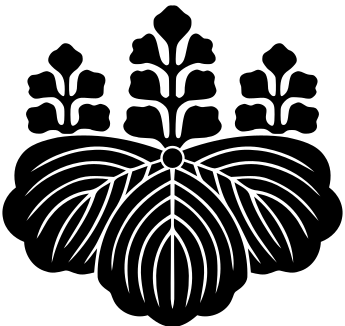
The Government of Japan (Go-Shichi no Kiri):
The 5-7 Paulownia.
Originally a clan crest, it is now the official emblem of the Prime
Minister and the Cabinet.
Kamon in the Modern World
A Living Legacy
Kamon remain a vibrant part of Japanese visual identity today.
-
Formal Attire: Featured on
Kuro-montsuki (formal black kimono) for weddings and
funerals.
-
Corporate Identity: Many global brands are based on
Kamon.
-
Mitsubishi: "Three Diamonds" (derived
from the water caltrop).
-
Kikkoman: The hexagon (tortoise shell)
representing longevity.
-
Modern Media: Extensively used in anime, manga, and
gaming to establish "House" identities for fictional
factions.